


Import 4K Blu-ray Discs: Compare HDR Retention and Costs

Updated: 4 days ago
A 4K label alone isn’t enough to judge an import. When you import 4K Blu-ray discs into Germany, compare each release’s HDR and Dolby Vision presentation alongside the order cost. The right minimum cost to consider is tied to the specific edition and purchase, not a generic euro figure.
Collectors know that the disc’s presentation and the edition itself both shape a worthwhile pick. This comparison shows how to assess HDR and Dolby Vision retention across imported 4K options, then weigh those details against the minimum order cost that matters for your decision. You’ll get a clear framework for comparing releases without confusing premium packaging with the picture formats you’re looking for. Start with the presentation, consider the complete purchase cost, and choose the edition that fits your priorities.
Table of Contents
Can individuals import 4K Blu-ray discs into Germany from outside the EU?
Individuals can import 4K Blu-ray discs into Germany, but each overseas order raises separate questions about shipment handling and playback compatibility. The disc’s country of origin doesn’t, by itself, tell you whether its HDR presentation or playback format suits your setup. Treat the seller’s dispatch location, the specific release, and your player as separate decision points.
Start with the dispatch origin. A title sold by a seller outside the EU may be shipped from a warehouse elsewhere, so check where the parcel actually leaves from when estimating import costs. Keep your order confirmation and shipment details together. They record the seller, title and parcel route, giving you a clear reference if you need to follow up on delivery.
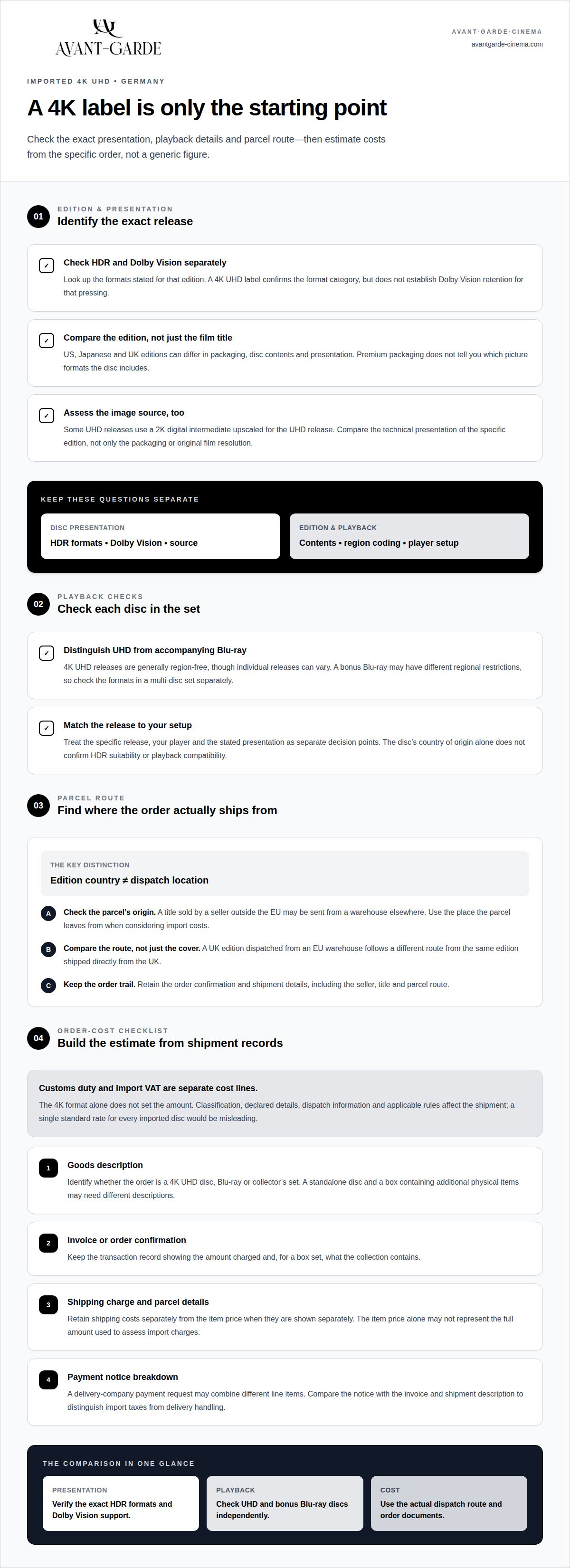
Next, identify the exact release rather than relying on a film’s title alone. A US, Japanese, or UK edition can differ in packaging, disc contents, and presentation. Check the edition’s stated HDR formats, including whether Dolby Vision is included. A 4K UHD label confirms the format category, but it doesn’t establish Dolby Vision retention for that particular pressing.
Region coding is another practical check. 4K UHD releases are generally region-free, although individual releases can vary. A release may therefore play on a region-compatible UHD setup, while an accompanying Blu-ray disc can have different regional restrictions. For a set containing both formats, distinguish the UHD disc from the bonus Blu-ray before ordering.
Resolution also deserves a title-specific look. Some 4K UHD releases use a 2K digital intermediate upscaled for the UHD release. That production detail doesn’t change the disc’s 4K format, but it can help collectors assess the source behind the image. Compare the listed technical presentation of the exact edition, not just the packaging or the original film resolution.
Finally, consider the physical format and the order’s route together. A 4K disc is a pressed physical release, not a digital download, and edition packaging may affect how you want it delivered and stored. Keep the product listing and order record available. For an outside-EU shipment, customs and import VAT are separate cost questions, addressed in the following sections; they shouldn’t be confused with region coding or HDR support. When you import 4K Blu-ray discs, evaluate those purchase and playback details together.
What customs duty and import VAT apply to 4K Blu-ray discs imported into Germany?
For a shipment entering Germany from outside the EU, customs duty and import VAT are separate cost lines. The 4K UHD format alone doesn’t establish the amount. The shipment’s customs classification, declared value, dispatch details, and applicable rules determine the charges. A single standard rate for every imported disc would therefore be misleading.
Customs duty depends on how the imported goods are classified. A standalone disc and a collector’s box containing discs and other physical items may need different descriptions. The invoice should identify the goods clearly, rather than using a vague label such as “media” or “collectibles.” Clear descriptions help customs authorities assess a shipment consistently—a principle that applies across all cross-border shipping, where trade compliance providers like Global4PL emphasize accurate import documentation and classification.
Import VAT is a separate consideration. The calculation depends on the import’s declared details and the rules applied to that shipment. The item price alone may not be the full amount used to assess import charges. For a boxed edition, keep the invoice showing the items and total paid, along with any stated transport costs.
Build your cost estimate from the order documents, not the disc’s format name. Keep these details together:
Goods description: Identify the 4K UHD disc, Blu-ray, or collector’s set precisely.
Transaction record: Keep the invoice or order confirmation showing the amount charged.
Shipping information: Retain the shipping charge and parcel details separately from the item price.
Collection contents: Note whether a set includes additional physical items alongside its discs.
For example, a single 4K title and a collector’s box set shouldn’t be treated as identical orders if their contents or declared values differ. The same applies when shipping charges appear separately on the invoice. These details provide the basis for understanding the shipment’s costs; they don’t guarantee a particular duty or VAT amount.
Also distinguish public charges from any separate amount collected by the delivery company. A payment request may combine different line items, so check the breakdown before treating the whole sum as tax. If the invoice, shipment description and payment notice use different wording, keep all three records. Comparing them can clarify whether a charge relates to the goods, import taxes or delivery handling.
Before placing an overseas order, compare the full landed-cost information available for that specific shipment. Duty classification and VAT treatment matter more than whether the cover says 4K, Dolby Vision, or limited edition. The following country comparison explains why the UK, US, and Japan should be considered by dispatch origin, not just by title or studio.
Customs classification depends on the goods’ description. A standalone disc and a collector’s box with additional physical items may be described differently. This section does not establish a specific EU customs tariff code.
The applicable VAT calculation depends on the import’s declared details and the rules applied to the shipment. The item price alone may not represent the full assessed amount, so keep any stated transport costs separately documented.
Customs duties for Blu-rays from UK, US, or Japan
A Blu-ray title’s country and the parcel’s dispatch point are different details. For a German order, find out where the package actually ships from before estimating import costs. A UK edition dispatched from an EU warehouse follows a different route from the same edition shipped directly from the UK. The US or Japan printed on a release does not, by itself, determine the parcel’s customs treatment.
There isn’t one reliable duty figure for every disc from the UK, US, or Japan. Customs treatment depends on the shipment’s classification and declared details, including what the parcel contains. A single 4K disc, a multi-disc set, and a collector’s box with additional physical items should not automatically be treated as identical goods. The country name alone cannot settle the calculation.
Use the order records to understand the shipment. An invoice can show the item description, transaction amount and shipping charge. The parcel declaration describes what is being imported. If a box combines UHD discs, standard Blu-rays and other contents, an itemised description is more useful than a generic “collectible” label.
For a practical comparison of the three origins, separate the questions:
UK: Check whether the parcel ships from the UK or an EU fulfilment location.
US: Match the invoice and parcel declaration to the specific edition and its contents.
Japan: Distinguish the release’s country from the place where the seller dispatches it.
These steps help explain why two copies of the same film can arrive with different import-cost details. One seller might ship an edition from stock within the EU, while another sends it directly from overseas. Packaging also affects the declared description: a standard case and a collector’s box can contain different goods, even when both feature the same film.
When a carrier requests payment, read each line rather than assuming the full amount is customs duty. The notice may separate taxes, customs-related charges and delivery handling. Compare it with the order invoice and shipment details. If the descriptions differ, these records help identify which parts of the transaction need clarification.
For any UK, US, or Japanese release, build your comparison around dispatch location, declared contents, and the parcel’s documentation. Then weigh those import details against the edition’s HDR presentation and packaging. Browse imported Blu-ray editions to find physical releases for your collection.
Avant-Garde-Cinema: Import Blu-rays
Avant-Garde-Cinema offers Import Blu-rays alongside 4K UHD + Blu-ray Limited Editions, Collector’s Editions, and Slipcover Editions. Turn to these physical-media options when you’re looking for an imported release or a particular presentation for your collection.
For a title under consideration, compare the edition details that matter to you: 4K UHD format, included Blu-ray discs, packaging, and the release’s stated HDR or Dolby Vision presentation. These details can help distinguish a standard import from a limited collector-focused edition without assuming every release shares the same specifications.
Choose the format and edition style that fit your shelf and viewing priorities. For questions about imported Blu-rays, contact Avant-Garde-Cinema.
Choose the Edition That Belongs in Your Collection
Your next import decision can start with the viewing experience you want, then move to the edition that delivers it. Before committing to a title, decide which matters most: HDR presentation, Dolby Vision, packaging, or a particular release’s place in your collection. That priority gives you a sharper basis for comparing editions than a 4K label alone.
To import 4K Blu-ray discs with confidence, treat playback details and import costs as part of the same purchase decision. A release can be compelling on screen and on the shelf, but the edition should still fit your equipment, collecting goals, and full order budget. Take time to weigh those factors together rather than choosing on artwork or scarcity alone.
Avant-Garde-Cinema offers 4K UHD + Blu-ray Limited Editions, Limited Collector’s Editions, and Limited Slipcover Editions for collectors seeking physical releases with distinct presentation. Explore the options that match your priorities, and contact Avant-Garde-Cinema about imports to take the next step. Find the edition that earns its place in your collection.



Comments