


Kenji Misumi Blu-ray Films and Box Set Availability

Four films, one focused set: the Kenji Misumi Blu-ray box set contains Zatoichi: The Blind Swordsman, Kill, The Sword and The Devil’s Blade. The collection brings together four films directed by Misumi, spanning 1962 to 1965.
For fans of Japanese period cinema, a Kenji Misumi Blu-ray collection brings together films featuring actors such as Shintaro Katsu and Raizo Ichikawa. Knowing which films are included, who stars in them and what the edition offers helps you decide whether the set belongs on your shelf.
This guide covers the four-film lineup, Misumi’s role, the performers associated with the collection, and its disc and presentation details. It also explains what to consider when assessing availability and how to explore specialist Blu-ray editions through Avant-Garde-Cinema.
Table of Contents
Director and cast
Kenji Misumi was born in Kyoto, Japan, on 2 March 1921, and directed more than seventy films. His career includes major titles in the Zatoichi and Lone Wolf and Cub series, alongside standalone period dramas. That range gives collectors a useful frame: a single box set can spotlight only part of a director’s substantial filmography. The Kenji Misumi Blu-ray collection’s credits identify Misumi as director, with Shintaro Katsu, Masayo Banri, Ryuzo Shimada, Raizo Ichikawa and Hajime Mitamura among its actors.
The Tale of Zatoichi is a 1962 Japanese chanbara film directed by Misumi, according to Wikimedia Foundation. Its place in the director’s work connects his name with the blind swordsman played by Shintaro Katsu. The character’s screen identity and Misumi’s direction make the film a key reference point for viewers tracing the Zatoichi series. Its 1962 release also places it among Misumi’s earlier films in the collection’s broader historical context.
Misumi’s credits extend across several decades. The Ghost of Yotsuya followed in 1959, while Hanzo the Razor: Sword of Justice arrived in 1972. The dates show how his filmography spans different periods of Japanese cinema. For collectors exploring titles beyond a focused set, these named credits help distinguish films directed by Misumi from works associated with the same genres or performers.
His Zatoichi work continued beyond the first film: Fight, Zatoichi, Fight dates to 1964, Zatoichi Challenged to 1967, and Zatoichi Goes to the Fire Festival to 1970. Misumi also directed Lone Wolf and Cub: Sword of Vengeance and Baby Cart at the River Styx, both released in 1972. These titles give fans clear starting points for following his series work across the 1960s and 1970s.
Kenji Misumi films available on Blu-ray
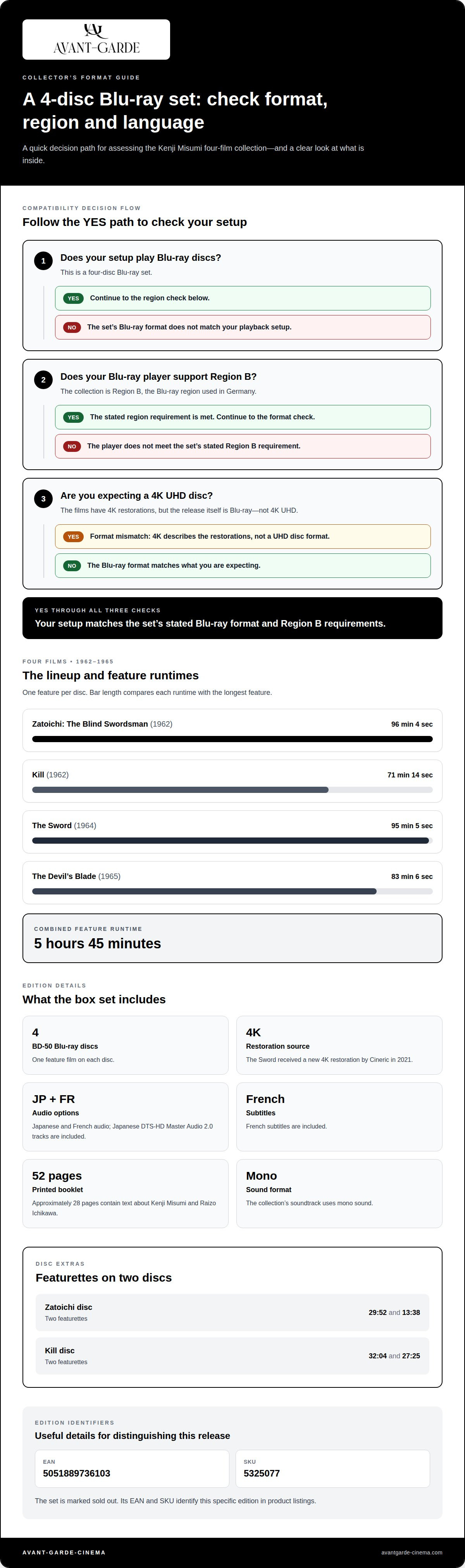
The four-film Blu-ray collection brings together titles from 1962 to 1965, rather than attempting to cover Misumi’s full filmography. Its lineup pairs Zatoichi with three sword-focused period films, making the set a compact introduction to different strands of his work. The release is identified by EAN 5051889736103 and SKU 5325077, useful details for distinguishing this edition in product listings.
The films are Zatoichi: The Blind Swordsman (1962), Kill (1962), The Sword (1964) and The Devil’s Blade (1965). Their runtimes are 96 minutes and 4 seconds, 71 minutes and 14 seconds, 95 minutes and 5 seconds, and 83 minutes and 6 seconds, respectively. Together, they run for 5 hours and 45 minutes. That spread gives the set a brisk opening with Kill and a longer feature in Zatoichi: The Blind Swordsman.
The collection’s films are restored in 4K for their Blu-ray presentation. The Sword received a new 4K restoration carried out by Cineric in 2021. For the Zatoichi disc, the video is encoded in MPEG-4 AVC at 1080p and 23.976 frames per second. The set also includes Japanese audio and French audio, with French subtitles. These language options are especially relevant to German collectors considering this French-import release.
Disc extras add context beyond the four features. The Zatoichi disc includes two featurettes, running 29 minutes and 52 seconds, and 13 minutes and 38 seconds. The Kill disc adds featurettes lasting 32 minutes and 4 seconds, and 27 minutes and 25 seconds. The set is marked sold out, so its EAN and SKU are practical identifiers when tracking this specific Blu-ray release.
For buyers comparing listings, the EAN 5051889736103 and SKU 5325077 can help confirm that a product page refers to the intended box rather than another Kenji Misumi release. This listed price offers a concrete point of reference for anyone assessing the set’s cost before purchase. Keeping the catalogue identifiers alongside the price may also make saved searches and retailer comparisons more precise. These details are useful whether a collector is checking a product record or comparing offers for this specific edition.
The four-film Kenji Misumi Blu-ray box set
This set is built around four feature films and four BD-50 discs, giving the collection a clear physical-media format. Its lineup brings together Zatoichi: The Blind Swordsman, Kill, The Sword and The Devil’s Blade. Rather than spanning every stage of Kenji Misumi’s career, it concentrates on four works from the 1960s.
The presentation pairs Japanese-language audio with French subtitles, while the soundtrack uses mono sound. Japanese DTS-HD Master Audio 2.0 tracks are included. These details matter to collectors weighing an imported edition: audio language, subtitle language and channel format shape the viewing experience as much as the film lineup. The collection also includes French audio.
A substantial extra is the 52-page booklet. Approximately 28 pages contain text about Kenji Misumi and Raizo Ichikawa, connecting the director’s work with one of the actors featured in the collection. That printed material gives the set a research component beyond its discs. It is a useful distinction for collectors who value contextual essays alongside restored features.
The four films are presented in 4K restorations on Blu-ray. This describes the restoration source, not a 4K UHD disc format: the collection is a four-disc Blu-ray set. That distinction helps identify what the box set delivers without confusing restoration resolution with playback format. The four BD-50 discs, Japanese DTS-HD Master Audio 2.0 and booklet form its core physical contents.
The box set brings together four features directed by Misumi, along with a printed booklet and specified audio options. It suits viewers focused on these films; collectors looking for a wider career survey can use the lineup as a starting point. The booklet’s coverage of Misumi and Ichikawa adds archival context to the selection.
Disc count, region and aspect ratio
The collection contains four Blu-ray discs, with one feature assigned to each BD-50. That layout keeps the four films on separate discs rather than grouping multiple features together. For shelf planning, the collection measures 14.1 × 3 × 17.3 cm. The compact dimensions describe the box, while the four-disc count identifies its playback format.
Region coding is an important compatibility detail for German collectors. This set is Region B, the Blu-ray region used in Germany, so your player must support Region B discs. DVD region settings do not determine Blu-ray compatibility. Check your player’s Blu-ray region support against the set’s Region B code.
The presentation uses a widescreen image format. These figures describe different parts of the presentation: 16:9 is the widescreen display shape, while 2.35:1 is the film image ratio. A widescreen image may not fill the screen, so black bars can appear. Black bars may therefore appear above and below the picture, preserving the film’s framing rather than stretching it to fill the screen.
Before choosing this Kenji Misumi Blu-ray set, read the technical details together. Four discs describe the physical layout; Region B identifies the Blu-ray playback code; and 2.35:1 signals the film’s wide composition. The collection’s Japanese audio and French subtitles are separate language specifications, not region settings. Keeping these details distinct helps you assess the release against your player and viewing preferences.
For collectors comparing physical editions, explore limited Blu-ray editions with their format and packaging details in view.
The Zatoichi disc adds an audio specification to the format details: a Japanese DTS-HD Master Audio 2.0 track at 48 kHz and 24-bit. This gives listeners a further playback detail to check alongside the disc’s region compatibility and the film’s widescreen presentation.
Avant-Garde-Cinema
Avant-Garde-Cinema helps collectors explore premium physical media when a specific film set prompts a wider search for carefully presented editions. Its range includes 4K UHD + Blu-ray Limited Editions, Limited Collector’s Editions, Limited Slipcover Editions and Steelbooks. These formats give collectors distinct options for building a shelf around physical releases, whether the priority is a special presentation or a collectible package.
When researching a Kenji Misumi Blu-ray, use the edition details to assess disc format, region, audio and subtitles. These checks are useful for other imported or limited physical-media releases, too. Avant-Garde-Cinema offers collectors a focused place to explore premium physical editions.
For help finding a suitable physical-media edition, contact Avant-Garde-Cinema.
Build Your Next Physical-Media Pick
A Kenji Misumi Blu-ray release can be a starting point for shaping a collection around Japanese cinema, restoration work and distinctive physical editions. From there, consider which titles and formats best fit your shelf: a focused film set, a presentation-led edition, or a broader run of favourites. The best next addition is the one that complements what you already collect.
Avant-Garde-Cinema offers 4K UHD + Blu-ray Limited Editions, 4K UHD + Blu-ray Limited Collector’s Editions and 4K UHD + Blu-ray Limited Slipcover Editions. These options give collectors different ways to build a physical-media library, with edition type and packaging as useful selection criteria.
If you’re ready to explore your next addition, contact Avant-Garde-Cinema. Keep following the films and editions that make your collection feel distinctly yours.
Frequently Asked Questions
Which Kenji Misumi films are available on Blu-ray?
The four-film collection discussed here features Zatoichi: The Blind Swordsman, Kill, The Sword and The Devil’s Blade. A film’s presence in Misumi’s directing credits does not establish that a Blu-ray edition exists. When searching for another title, distinguish a documented disc release from a filmography listing.
What are the best Kenji Misumi box sets and collections?
The four-film French-import collection is the specific set covered in this guide. What counts as “best” depends on your priorities: a newcomer may prefer a compact, director-focused selection, while a completist may want to trace individual series entries across releases. Treat this set as a curated sample of Misumi’s work, not a complete filmography or a ranking of editions.
Are Kenji Misumi Blu-rays available in 4K or restored editions?
The collection’s films have 4K restorations, but the release itself is on Blu-ray, not 4K UHD. That distinction matters when comparing product descriptions: “4K restoration” refers to restoration work, while “4K UHD” identifies a disc format. For collectors comparing a Kenji Misumi Blu-ray with UHD releases, the restored The Sword is an example of a restoration presented on Blu-ray.
Comments