


Why High Bitrate 4K UHD Movies Outperform Streaming in 2026

Why does your high-end OLED screen still struggle with macroblocking in dark scenes while watching a blockbuster on a premium streaming service? It's a frustrating reality for enthusiasts. Despite the "4K" badge, most digital platforms throttle data to a fraction of what's necessary for true cinematic fidelity. You've likely noticed that "soft" look or the lack of dynamic audio punch that leaves your home cinema feeling hollow. The technical truth is that high bitrate 4k uhd movies offer a level of data density that streaming infrastructure simply cannot match in 2026.
You've invested in the hardware, so it's time to stop settling for the limitations of a compressed signal. This article breaks down the technical metrics of bitrate and explains why physical media is the only way to preserve the grain, depth, and soul of the original film master. We'll justify the investment in physical formats by comparing BD-100 triple-layer specs against current streaming averages. From lossless audio codecs to the superior encoding of boutique labels, you'll discover exactly what to look for in a premium disc release to ensure your collection meets archival standards. It is time to experience your favorite films without compromise.
Table of Contents
Understanding Bitrate: The Heart of True 4K UHD Quality
Bitrate represents the volume of data processed every second, typically measured in Megabits per second (Mbps). While the marketing for streaming platforms focuses heavily on the "4K" label, that number only describes the pixel grid of 3840 x 2160. It doesn't account for the depth, color accuracy, or stability of those pixels. Think of 4K as a bucket; bitrate is the actual amount of water inside it. A high resolution image with a low bitrate results in "empty" pixels that lack nuance and sharp edges. Bitrate is the "speed limit" of cinematic detail.
Compression is the invisible thief of the home cinema world. It's a necessary evil for the web, but it has no place in a dedicated collector's library. The relationship between file size and visual fidelity is direct. High bitrate 4k uhd movies utilize the massive 100GB capacity of triple-layer discs to minimize compression artifacts. When data is squeezed to fit limited streaming bandwidth, the encoder discards "unnecessary" information. This process destroys subtle gradients in a sunset or the fine textures of a costume. Physical media avoids these compromises by maintaining a high data ceiling that honors the director's vision.
Mbps vs. Gbps: Decoding the Numbers
Don't confuse your internet bandwidth with the actual bitstream. A 1Gbps connection is just the width of your pipe, but the streaming provider controls the flow. Most platforms cap 4K content at a meager 15 to 25 Mbps to manage server load. In contrast, a 4K UHD disc delivers a dedicated stream directly to your player's processor. A high-end player sustains bitrates of 100Mbps or more without the latency or packet loss inherent in cloud delivery. This hardware-based processing ensures a stable, uncompromised signal that never drops in quality during peak hours.
The Impact of Bitrate on Cinematic Grain and Texture
Preserving the organic texture of a 35mm film scan is the ultimate test for any format. High bitrate discs excel here because they have the data overhead to render fine film grain without turning it into digital mush. Streaming encoders often view grain as "noise" and scrub it away, resulting in a waxy, artificial image. High-motion scenes, such as a fast car chase or falling snow, require massive data spikes to prevent the image from falling apart. High bitrate 4k uhd movies maintain their integrity during these moments, while streaming often collapses into visible macroblocking and blurry textures.
The Physics of Physical Media: Why Discs Beat the Cloud
Physical discs operate on a local hardware loop. Unlike streaming, which relies on the volatile nature of external servers and the "best-effort" delivery of the internet, high bitrate 4k uhd movies on disc are read directly by a laser in your player. This eliminates the risk of ISP throttling or network congestion during peak evening hours in Germany. Even with the advancements in 2026's HEVC (H.265) encoding, streaming services still prioritize bandwidth efficiency over visual integrity. Discs use the same codec but apply it with a significantly higher profile and lower compression ratios, resulting in a cleaner, more stable image.
Data management on a disc is fundamentally superior due to how it handles Variable Bitrate (VBR). Streaming platforms often use aggressive "capped" VBR to prevent buffering on slower connections. Discs allow the bitrate to spike massively during complex scenes, such as chaotic explosions or dense forest foliage, without the image breaking into macroblocks. It's a localized powerhouse. The physical spin of the disc provides a constant, reliable data flow that the cloud simply can't guarantee, regardless of your home's fiber speed.
Triple-Layer BD-100: The Gold Standard for Collectors
The BD-100 format is the pinnacle of current storage technology. With 100GB of real estate, it provides the headroom necessary for feature films to breathe. While standard BD-66 discs are common for shorter films, boutique labels often opt for BD-100 to maximize the bitstream. This extra capacity is critical for housing heavy HDR10+ or Dolby Vision metadata, ensuring that every frame's peak brightness and color saturation are rendered perfectly. You can find these high-spec 4K UHD limited editions that utilize the full potential of triple-layer technology for a truly uncompromised image.
Audio Bitrate: The Forgotten Half of the Experience
Audio is often where streaming compromises most. Digital platforms use lossy codecs like Dolby Digital Plus, which discard significant sonic data to save space. Physical media delivers lossless audio via DTS-HD Master Audio or Dolby TrueHD. The difference in dynamic range is immediate. On disc, the "punch" of a low-frequency effect or the clarity of a whisper remains intact. Object-based tracks like Dolby Atmos or DTS:X benefit from the higher audio bitrate, providing a precise, immersive soundstage that streaming's compressed tracks simply cannot replicate.
Disc vs. Streaming: Measuring the Massive Data Gap
In 2026, the data gap between cloud delivery and physical media remains a chasm. While major streaming platforms have refined their encoders, they still operate within the constraints of public internet infrastructure. A typical 4K stream from a top-tier provider averages between 15 and 25 Mbps. In stark contrast, high bitrate 4k uhd movies on a BD-100 disc regularly peak between 80 and 128 Mbps. This isn't just a marginal gain; it's a four-to-five-fold increase in raw information. When you watch a stream, the "4K" label refers only to the pixel dimensions. In terms of actual data density, a compressed 4K stream is often technically inferior to a well-mastered 1080p Blu-ray disc, which can sustain bitrates of 35 to 40 Mbps.
Streaming services prioritize the "no-buffer" experience above all else. To prevent your movie from pausing, the player uses Adaptive Bitrate Streaming. If your network or the provider's server fluctuates even slightly, the quality silently drops. You might not see a loading circle, but the image softens and the fine detail vanishes. A disc never makes this compromise. It is a dedicated local server with zero latency, providing a consistent, high-fidelity experience from the first frame to the last. This reliability is why the most discerning collectors in Germany continue to favor physical formats over the volatility of the cloud.
Shadow Detail and Color Banding
Dark scenes are where compression fails most visibly. Because low-bitrate encoders struggle to differentiate between subtle shades of black and grey, they "crush" the shadows into flat, blocky patches. This macroblocking destroys the atmosphere of a moody thriller, turning a director's careful lighting into a pixelated mess. High bitrate 4k uhd movies provide the necessary data to support smooth 10-bit color transitions. This eliminates color banding, the ugly "staircase" effect often seen in digital skies or underwater shots, ensuring the image remains filmic and deep.
The Stability of the Physical Connection
The reliability of physical media extends beyond visual performance. When you load a disc, you aren't at the mercy of a data center's uptime or your ISP's routing efficiency. Collectors value this stability because it guarantees the highest possible quality every time. There's no risk of a "soft" image during peak hours or a sudden resolution drop when someone else in the house starts a download. Owning the data physically ensures that your cinematic experience is insulated from the volatility of the cloud, preserving the master-quality transfer as it was intended to be seen.
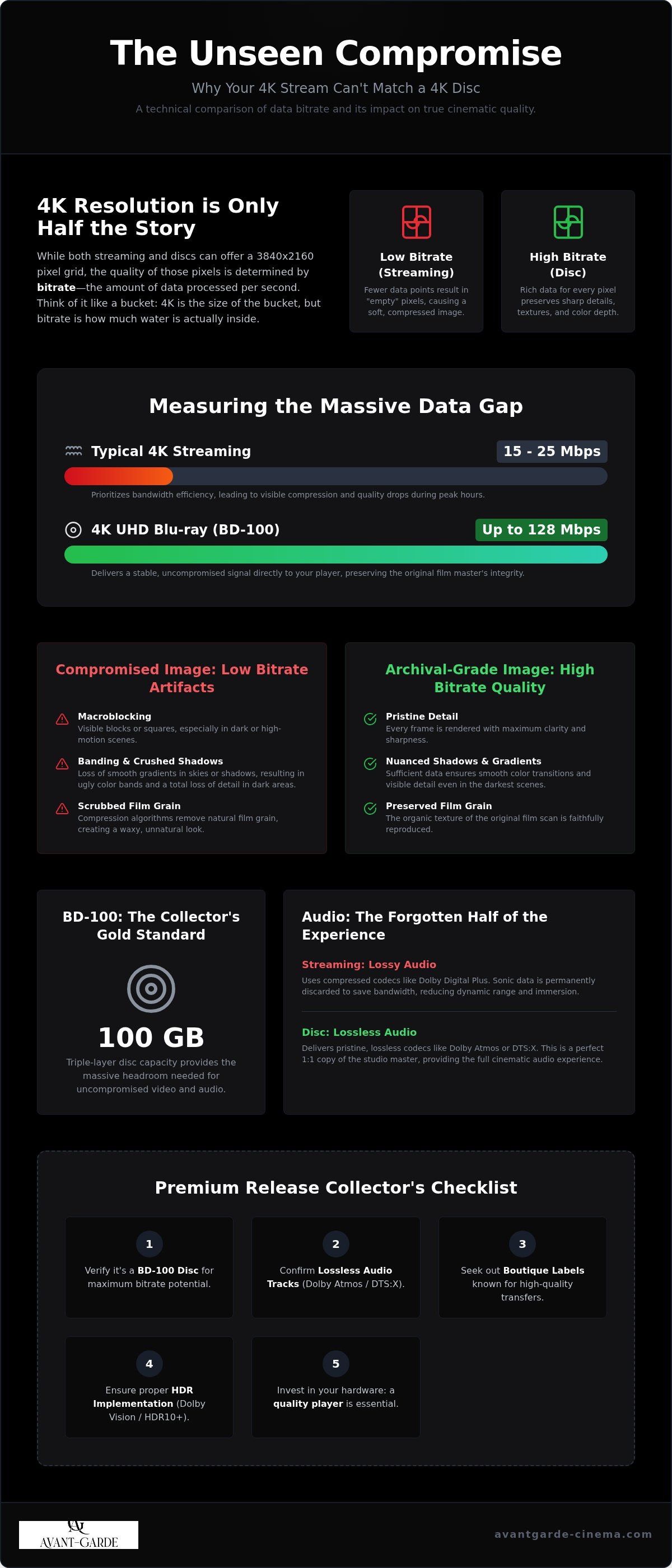
How to Spot High Bitrate Masterpieces: A Collector’s Checklist
Identifying high bitrate 4k uhd movies requires a keen eye for technical specifications that go beyond the front cover art. Start with the physical medium itself. A BD-100 triple-layer disc is the preferred choice for any feature-length film aiming for reference-quality status. While a BD-66 might suffice for a short runtime or a visually simple production, it lacks the headroom for a three-hour epic or a film with heavy organic grain. The extra 34GB on a BD-100 allows for the sustained 80 to 100 Mbps peaks that prevent compression artifacts during complex sequences. Always verify the disc type through community databases or technical reviews before adding a title to your library.
Mastering sources play a pivotal role in the final output you see on screen. A native 4K transfer, scanned directly from the original camera negative, provides a level of detail that a 2K Digital Intermediate (DI) upscale can't reach. Look for specific language on the packaging or in the product description. Phrases like "New 4K restoration from the original 35mm negative" indicate a commitment to archival quality. If a release uses a 2K upscale, a high bitrate is even more critical to ensure the upscaling process doesn't introduce unwanted noise or artificial smoothing that ruins the filmic texture.
Identifying Premium Boutique Transfers
Boutique labels are the guardians of physical media quality in a market dominated by digital convenience. Specialized distributors understand that their audience demands perfection. Unlike mass-market studio releases, boutique editions often feature bespoke encodes handled by renowned compressionists. These labels prioritize data density over cost-cutting, frequently opting for triple-layer discs even when a double-layer might technically fit the file. You can browse a curated selection of these 4K UHD limited collector's editions to see how premium packaging and technical excellence go hand-in-hand.
The Importance of HDR Implementation
HDR implementation is the final piece of the high-fidelity puzzle. Formats like Dolby Vision and HDR10+ require significant data to manage dynamic metadata effectively. When bitrate is restricted, the HDR layer suffers first, leading to "shimmering" in bright areas or unstable color gradients in the sky. The Triple Layer Advantage for high-end home cinemas provides the necessary bandwidth to render 12-bit color depth and peak luminance without compromising the base 4K image. High bitrate ensures that your HDR display actually receives the complex instructions it needs to perform at its maximum potential.
Curating Your Collection with Premium Boutique 4K UHD Editions
Collecting physical media is an act of preservation. While digital platforms treat cinema as a disposable stream, boutique labels view every release as a definitive archival statement. For the dedicated enthusiast, limited edition 4K UHD releases represent the pinnacle of home cinema. These editions don't just offer the highest possible technical specs; they provide a physical connection to film history. Investing in high bitrate 4k uhd movies ensures that your library is immune to the volatility of digital licensing agreements, where titles can vanish from your "purchased" list overnight. A physical disc remains on your shelf, ready to deliver a reference-quality experience whenever you demand it.
The aesthetic value of a premium release is a major draw for collectors in Germany. A standard plastic case can't compete with the craftsmanship of 4K UHD + Blu-ray Steelbooks or Limited Slipcover Editions. These items are designed to be showcased. Between the heavy-gauge cardstock of a collector box set and the exclusive scan-based artwork, every element reflects the quality of the data on the disc. Avant-Garde-Cinema is built by collectors who share this obsession with bitrate and presentation. We understand that the tactile joy of unboxing a rare import is just as important as the 100Mbps bitstream it contains.
The Exclusivity of Limited Run Editions
Boutique labels often produce superior technical transfers because they cater to a niche, demanding audience. These specialized houses invest in painstaking restorations, often outperforming the standard studio encodes found in big-box retailers. The rarity factor is real. Many of these 4K UHD + Blu-ray Limited Collector's Editions are printed in small batches, making them future gems that hold their value. Sourcing these titles often involves looking toward specialized film imports, ensuring your collection contains the absolute best version of a film available globally.
Start Your High-Bitrate Journey Today
Transitioning from a casual viewer to a serious collector changes how you perceive cinema. You stop looking at the resolution and start noticing the texture of the grain and the stability of the shadows. It's about the uncompromising pursuit of the director's original vision. There is a profound sense of satisfaction in owning a master-quality transfer that no streaming app can replicate. The reliability of the format, combined with the premium packaging, makes every viewing an event. If you are ready to elevate your home cinema, explore our curated selection of high bitrate 4K UHD movies at Avant-Garde-Cinema and secure the editions your setup deserves.
Secure the Future of Your Home Cinema
The technical gap between a 25 Mbps stream and a 128 Mbps disc is the difference between simply seeing a movie and truly experiencing it. You've discovered how high bitrate 4k uhd movies protect against macroblocking while preserving the organic texture of 35mm film grain. By prioritizing BD-100 triple-layer discs and boutique transfers, you ensure your home cinema hardware performs at its technical ceiling. Physical media isn't just a format; it's a commitment to archival quality and sensory immersion that volatile digital platforms can't replicate.
As Germany's premier destination for boutique physical media, Avant-Garde-Cinema is built by collectors who demand the highest bitrates. We specialize in rare, out-of-print, and limited edition imports that honor the director's original master. It's time to stop settling for compressed cloud data and low-bandwidth compromises. Upgrade your home cinema with premium 4K UHD Limited Editions at Avant-Garde-Cinema and rediscover your favorite films in their purest, most detailed form. Your collection deserves reference-quality excellence.
Frequently Asked Questions
What is the average bitrate of a 4K UHD Blu-ray disc?
A 4K UHD Blu-ray disc typically maintains an average bitrate between 60 and 100 Mbps, with peaks reaching the 128 Mbps limit of the BD-100 format. This sustained data flow is significantly higher than the 15 to 25 Mbps averages found on mainstream streaming platforms in 2026. These higher bitrates ensure that complex visual information, like fine film grain or fast-moving action, remains sharp and free from digital artifacts.
Can I see the difference between streaming 4K and a 4K disc on a 55-inch TV?
Yes, the difference is noticeable even on a 55-inch screen, particularly in high-contrast or dark scenes. While the pixel count is the same, the disc provides better depth and smoother color gradients. You'll notice less macroblocking in shadows and a more natural, filmic texture. High bitrate 4k uhd movies prevent the "waxy" look often caused by aggressive streaming compression, making the image appear sharper and more detailed during close-ups.
Why do some 4K movies look better than others on disc?
Visual quality depends on the source material and the encoding process. A native 4K scan from the original camera negative will always outperform an upscale from a 2K Digital Intermediate. Additionally, the skill of the compressionist matters. Boutique labels often spend more time optimizing the bitstream for every frame, while major studios might use automated encoders that prioritize fitting the film onto a smaller, cheaper disc format to save on manufacturing costs.
Does high bitrate affect the sound quality of the movie?
High bitrate is essential for delivering lossless audio formats like Dolby TrueHD and DTS-HD Master Audio. Streaming services typically use lossy Dolby Digital Plus, which discards sonic data to save bandwidth. On a physical disc, the audio bitstream has enough headroom to preserve the full dynamic range of the original mix. This results in more powerful bass, clearer dialogue, and a more precise immersive soundstage for Atmos or DTS:X setups in your home cinema.
What equipment do I need to enjoy high bitrate 4K UHD movies?
To experience high bitrate 4k uhd movies, you need a dedicated 4K UHD Blu-ray player, a 4K HDR-capable television, and a high-speed HDMI 2.0 or 2.1 cable. Gaming consoles with disc drives can work, but standalone players often feature better processing chips for video decoding. For the best results, pair your player with an OLED or high-end LED screen that supports HDR10+ or Dolby Vision to fully resolve the extra data provided by the disc.
Is a 4K stream faster than a 4K Blu-ray disc?
Streaming is "faster" only in terms of instant access and convenience. However, a 4K Blu-ray disc has a much higher internal transfer speed, reading data at up to 128 Mbps directly from the hardware. A stream is limited by your internet connection and the provider's server caps. Even with 2026 fiber speeds, the cloud cannot match the consistent, high-velocity data delivery that a physical laser provides within a local, uncompressed playback loop.
Are boutique label 4K releases better than major studio releases?
Boutique labels frequently outperform major studios because they cater to collectors who demand archival quality. These labels often invest in new 4K restorations and use BD-100 triple-layer discs to maximize the bitrate. Major studios sometimes prioritize mass production costs, which can lead to higher compression or the use of smaller BD-66 discs. Boutique editions also include premium packaging and exclusive supplements that add significant value for enthusiasts looking for the definitive version of a film.
Why are some 4K UHD discs labeled as BD-66 or BD-100?
These labels indicate the storage capacity of the disc. A BD-66 is a dual-layer disc holding 66GB, while a BD-100 is a triple-layer disc with 100GB of space. Collectors prefer BD-100 because the extra capacity allows for higher bitrates and more room for lossless audio and HDR metadata. For a feature film, the larger disc ensures the image doesn't suffer from compression artifacts during scenes with high visual complexity or dense organic textures.


Comments